Two more petroleum-based food dyes are on their way out of the American food supply. On July 22, 2026, the FDA issued a final order revoking Orange B — a coal-tar dye once used to color hot dog and sausage casings — and formally proposed ending the use of Citrus Red No. 2, the dye sprayed on the skins of some mature oranges since 1959. For anyone who reads ingredient labels and cares about what actually goes into their food, this is a moment worth understanding, because it tells you exactly which synthetic colors are still lurking and how to find them yourself.
What the FDA Actually Did in July 2026
The agency took two separate but related actions. First, it finalized the revocation of Orange B, a petroleum-derived dye regulated under 21 CFR 74.250. Orange B was last certified for use back in 1978, meaning the industry had effectively abandoned it decades ago — the FDA simply cleaned an outdated authorization off the books. Both actions were reported by Quality Assurance & Food Safety, which noted the agency framed both dyes as color additives that industry had already left behind.
Second, the FDA proposed revoking Citrus Red No. 2. This one is not final yet. It is a proposal open to public comment through August 24, 2026, under Docket FDA-2026-N-6304. Citrus Red No. 2 has an unusual history: since 1959 it has been permitted only to color the skins of mature oranges that are not intended for processing — never the flesh, and never for juice. It was a cosmetic dye for produce, essentially, making green-tinged oranges look ripe.
Both are petroleum-derived. Both were, in the FDA's telling, dyes that manufacturers had quietly stopped relying on. If you want to weigh in on the Citrus Red No. 2 proposal, the comment window is genuinely open, and public dockets do influence how these rules get finalized.
Why This Is Bigger Than Two Obscure Dyes
Orange B and Citrus Red No. 2 are the tail end of a much larger shift. In April 2025, the Department of Health and Human Services and the FDA announced a plan to phase out six widely used petroleum-based dyes from the food supply: Red 40, Yellow 5, Yellow 6, Blue 1, Blue 2, and Green 3. These are not obscure — they are the colors in candy, cereal, sports drinks, frosting, and thousands of packaged snacks.
Ahead of that announcement, the FDA had already revoked the food authorization for Red No. 3 in January 2025, setting a reformulation deadline of January 15, 2027, for manufacturers to remove it from food. Red No. 3 had been linked to cancer in laboratory animals and banned from cosmetics decades earlier, so its removal from food closed a long-standing gap.
So the July 2026 news is not an isolated headline. It is one more brick pulled from a wall that regulators have decided is coming down. The direction is unmistakable: petroleum-derived synthetic colors are being pushed out, and naturally derived alternatives are being fast-tracked in.
How to Spot Petroleum Dyes on Your Own Labels
Here is the practical part. You do not need to wait for a regulator to protect you — you can read the ingredient list today and know exactly what you are looking at. Petroleum-based synthetic dyes almost always appear under an FD&C name followed by a color and a number. Train your eye on these:
- FD&C Red No. 40 (also called Allura Red) — the most common dye in the U.S. food supply
- FD&C Yellow No. 5 (Tartrazine) — in chips, cereals, pickles, and drinks
- FD&C Yellow No. 6 (Sunset Yellow) — in snack foods and baked goods
- FD&C Blue No. 1 (Brilliant Blue) — in candies and beverages
- FD&C Blue No. 2 (Indigotine) — in cereals and pet foods
- FD&C Green No. 3 (Fast Green) — less common, in canned peas and some candy
- FD&C Red No. 3 (Erythrosine) — being removed by January 2027
A quick rule: if a color name on the label has a number attached to it, it is almost certainly a certified synthetic dye derived from petroleum. Natural colorings do not carry FD&C numbers. When a label reads "colored with beet juice" or "turmeric" or "spirulina extract," you are looking at a plant-based pigment instead.
Reading labels is easier when you are cooking and storing more of your own food. Keeping ingredients visible in clear glass food storage containers makes it obvious what is a whole food and what came out of a dyed package — you can see the real color of what you are eating. As an Amazon Associate we earn from qualifying purchases.
The Natural Colors Replacing Them
The FDA is not just removing dyes — it is actively fast-tracking approvals for naturally derived color additives to fill the gap. If you want to understand what the "clean" version of a colored food looks like, these are the pigments doing the work:
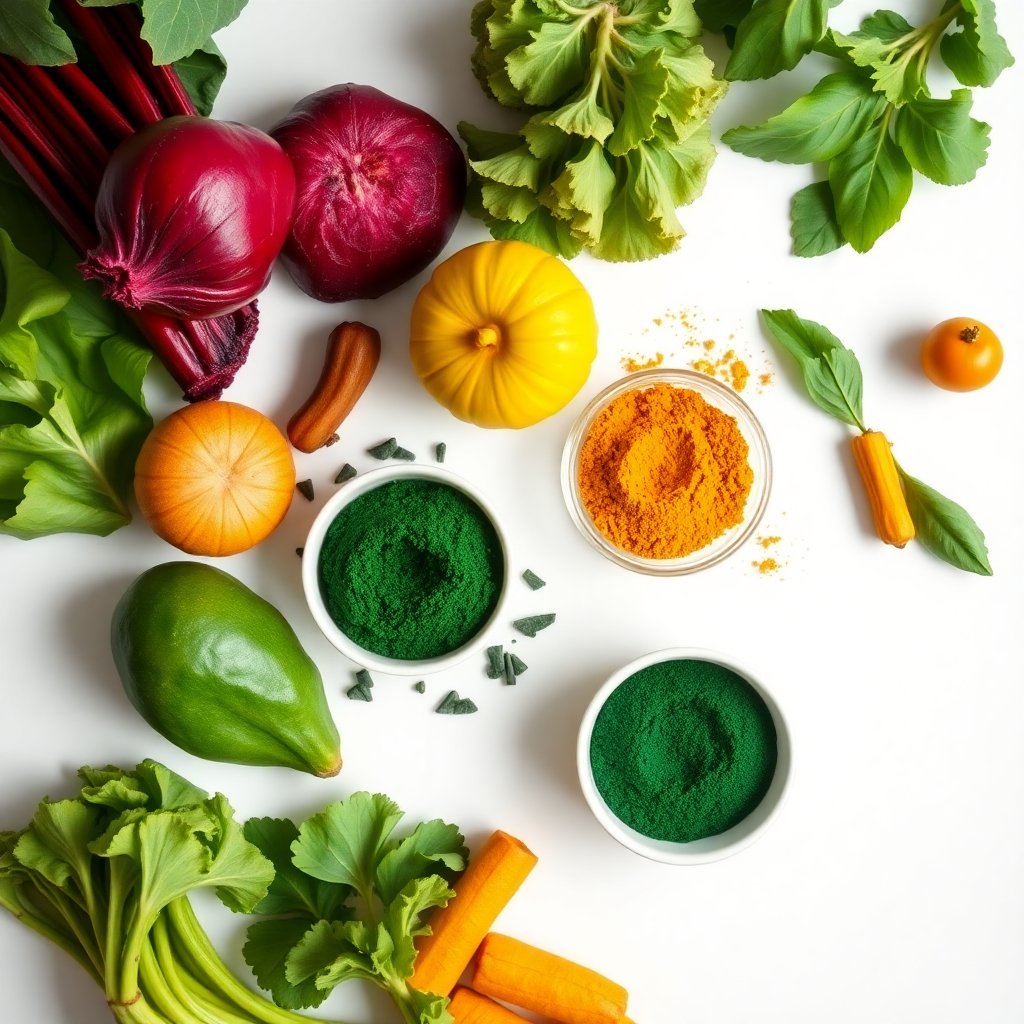
Beet and beetroot red. Betanin, the pigment in beets, delivers deep pinks and reds. It is already common in yogurts, some plant-based meats, and natural candies. You can add it to your own kitchen with beet root powder to color smoothies, frostings, and raw desserts without a single synthetic dye.
Spirulina. This blue-green algae is the FDA's answer for blues and greens — the exact shades that were hardest to reproduce naturally. Regulators have been expanding spirulina's approved uses precisely because Blue 1, Blue 2, and Green 3 are on the way out. A jar of spirulina powder turns raw energy balls and smoothie bowls a vivid natural green, and it brings iron and protein along with the color.
Turmeric and annatto. Turmeric gives a warm golden yellow; annatto (from achiote seeds) produces oranges and yellows and has colored cheeses and butters for generations. Between the two, most of the yellow-orange range that Yellow 5 and Yellow 6 once covered can be reproduced from plants.
For fully custom color work, general-purpose plant based natural food coloring kits combine these pigments into ready-to-use sets — handy if you bake, decorate, or make raw treats and want to skip the FD&C numbers entirely.
The Brands Already Moving
You do not have to imagine this shift — major manufacturers are announcing it publicly. Target has pledged to make its owned-brand cereals free of synthetic dyes. General Mills committed to removing artificial colors from Lucky Charms, and WK Kellogg said it would pull synthetic dyes from Froot Loops, both targeting the end of 2027. These are exactly the ultra-colorful, kid-marketed products that leaned hardest on petroleum dyes, so their reformulation says a lot about where the market is heading.
That said, "reformulated" and "whole food" are not the same thing. A cereal switching from Red 40 to beet juice is a genuine improvement on the dye question, but it is still a processed cereal. The most reliable way to avoid synthetic dyes is the same principle that avoids most questionable additives: eat foods that never needed a color added in the first place.
A Simple Whole-Food Approach to Avoiding Dyes
If you want a system rather than a rule to memorize, here is one that works.
Shop the produce section first. A carrot, a beet, a bunch of kale — none of these carry an ingredient label because there is nothing to disclose. The color is the food. Building meals around raw and lightly prepared produce sidesteps the entire dye question. If you are new to eating this way, our guide to the best sprouting kits for a raw vegan kitchen is a low-cost way to start growing living food on your counter.
Read every new packaged item once. You do not need to audit your whole pantry in a day. Just check each new product before it enters your kitchen. Scan for FD&C numbers. If you see one, decide whether there is a naturally colored version — there increasingly is.
Store food so you can see it. Clear jars and containers make whole ingredients the default and packaged, dyed foods the exception. The same logic extends to how you keep your kitchen clean and low-waste — swapping in natural food wraps and plastic-free storage reduces both synthetic packaging and the temptation of grab-and-go dyed snacks.
Keep your tools clean and simple, too. A whole-food kitchen is a hands-on kitchen, and the fewer synthetic materials touching your food, the better. Even small choices like using natural dish brushes fit the same philosophy that drives dye-free eating: fewer petroleum-derived materials in contact with what you eat.
What to Watch Next
The Citrus Red No. 2 comment period closes August 24, 2026, and if the FDA follows through, that authorization joins Orange B in the history books. The larger six-dye phase-out will unfold over the next couple of years, with the Red No. 3 deadline of January 15, 2027, acting as an early marker of how quickly the industry can reformulate at scale. Some of these timelines are targets and pledges rather than hard legal deadlines, so expect the pace to shift as it plays out.
None of this requires you to wait. The regulatory machinery is slow by design, but your grocery cart is not. Every time you choose a naturally colored food — or color your own with beets, spirulina, turmeric, or annatto — you are already living on the far side of the ban. The labels are telling you everything you need to know. You just have to look for the numbers.
The Bottom Line
The FDA's July 2026 revocation of Orange B and its proposal to end Citrus Red No. 2 are small moves inside a much larger retreat from petroleum-based food dyes. Six major synthetic colors are being phased out, Red No. 3 is already gone, and big brands are reformulating. You can stay ahead of all of it with one habit: read the ingredient list, watch for FD&C color numbers, and lean toward foods whose color comes from the plant itself. Whole-food eating was already the cleaner path — this just makes the reasoning impossible to ignore.
As an Amazon Associate we earn from qualifying purchases. This article contains affiliate links; if you buy through them we may earn a small commission at no additional cost to you.